
Ancillary services for travel agents have quietly become one of the most effective ways to grow revenue without increasing operational complexity. While flights, hotels, and rail bookings remain the foundation of most travel businesses, margins on these core products continue to tighten year after year.
Rising competition, fare transparency, and supplier-driven pricing mean that relying only on commissions from core bookings is no longer enough for consistent growth. This is where ancillary services in travel and true ancillary services come into focus.
These services are sold alongside a core booking and are designed to enhance the traveler’s journey rather than replace the main product. For agents evaluating how travel agents increase revenue in a sustainable way, ancillary services in travel offer an opportunity to increase booking value without significantly increasing workload or operational risk.
When positioned correctly, ancillary services in travel for travel agents feel less like add-ons and more like thoughtful extensions of the travel experience.
Understanding the Ancillary Landscape
The ancillary landscape in travel has evolved significantly over the past decade. What was once limited to seat upgrades or excess baggage has expanded into a wide ecosystem that supports travelers before departure, at the airport, during transit, and even after arrival. This evolution has reshaped how ancillary services in travel are perceived and sold.
Today’s travelers expect flexibility, personalization, and convenience. Ancillary services in travel help meet these expectations while allowing agents to offer more complete travel solutions. Understanding this broader travel ancillary services ecosystem enables agents to recommend services based on journey type, traveler profile, and destination rather than offering generic add-ons.
The most successful agents treat ancillary services in travel as an integral part of travel planning, seamlessly layered into the booking process rather than presented as last-minute options.
Also Read – 8 Crucial Steps To Get A Travel Agent License In India (2026 Guide)
Air Ancillary Services: Where Demand Is Growing Fastest
Among all categories, air ancillary services continue to see the strongest and most consistent demand within ancillary services in travel. As airlines unbundle fares and shift more services into optional purchases, travelers increasingly rely on agents to help them navigate these choices.
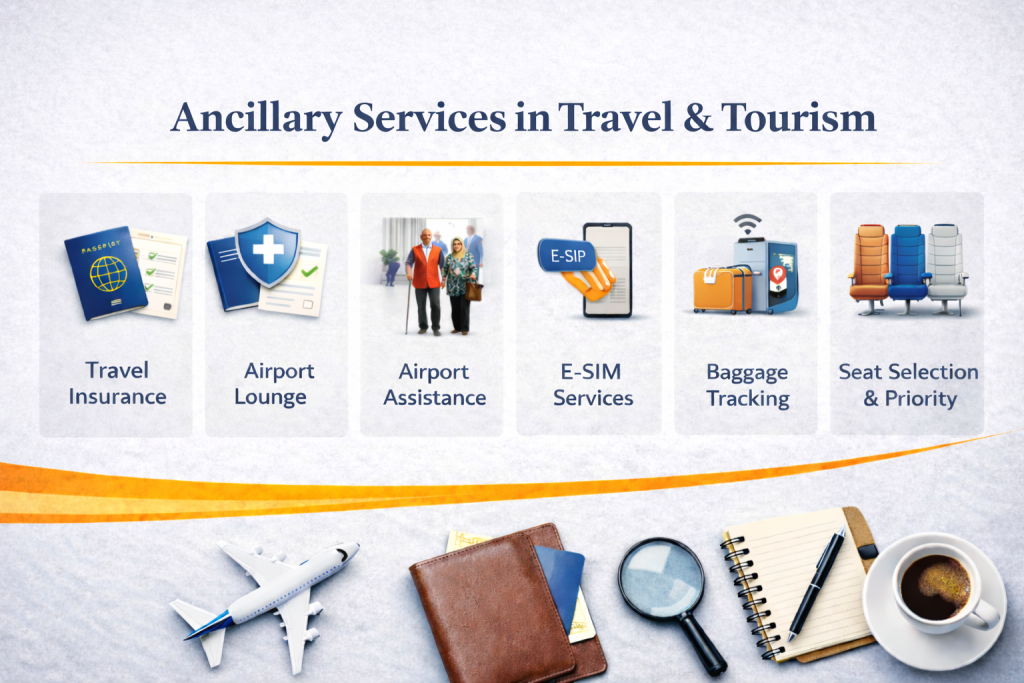
Airport assistance services support travelers through busy terminals, immigration queues, and security processes. These services are especially valuable for senior travelers, families with children, first-time international flyers, and passengers with tight connections.
Airport lounge access remains one of the most widely accepted travel ancillary services. With fewer complimentary lounge benefits available, travelers are more willing to pay for comfort, reliable Wi-Fi, refreshments, and quiet workspaces, particularly during long layovers or delays.
E-SIM services have emerged as a preferred connectivity solution for international travelers. Offered as a pre-trip ancillary, e-SIMs allow travelers to stay connected immediately upon landing, eliminating the need to search for local SIM cards or rely on expensive roaming plans.
Baggage tracking services respond to a growing concern around luggage handling. Real-time tracking and alerts provide reassurance, especially for travelers with multiple connections. When combined with baggage protection services, they form a strong peace-of-mind offering that feels highly relevant rather than optional.
Travel tags and smart travel accessories, though simple, play an important role in the broader ancillary services in travel ecosystem. These tools help improve baggage identification and recovery and are particularly useful for frequent travelers and long-haul journeys.
Together, these air ancillary services create multiple low-friction opportunities for ancillary revenue for travel agents, while strengthening the overall value of ancillary services in travel for both agents and travelers.
Core True Ancillary Services Travel Agents Can Offer
Travel insurance add-ons remain one of the most consistent and widely accepted true ancillary services within ancillary services in travel. Typically sold alongside flights or holiday packages, insurance provides coverage for medical emergencies, cancellations, and baggage-related disruptions. For agents, insurance aligns naturally with most bookings and delivers predictable ancillary revenue.
Seat selection and priority services allow travelers to personalize their journey further. Whether it is choosing preferred seating, priority boarding, or fast-track airport services, these ancillaries give travelers greater control over comfort and time. When presented clearly during booking, they also reduce post-booking dissatisfaction.
Multi-utility services, including SIM cards, foreign exchange, and essential travel utilities, support travelers in the pre-departure phase. While individually modest, these services add up when bundled and contribute to smoother journeys, creating additional income opportunities for travel agents without complicating operations.
Also Read – Must-Attend Travel Trade Exhibitions in 2026
3 Quick Tips for Selling Ancillary Services
Position ancillaries as part of the overall travel plan, focusing on relevance and timing rather than aggressive upselling. Travelers respond better when services feel connected to their journey.
Offer ancillaries at multiple touchpoints, including during booking, at payment, and post-booking, when travelers may reassess their needs.
Operational simplicity matters. Managing ancillary services in travel through a single platform like Riya Connect helps reduce complexity and ensures a smoother booking experience.
Ancillary services are about offering relevant options that improve the travel experience while creating additional income for travel agents. As competition increases and margins on core products continue to tighten, agents who rely only on primary bookings may find growth increasingly challenging.
Those who understand ancillary services in travel and gradually integrate true ancillary services and air ancillary services into their workflow are better positioned to build stronger customer relationships, healthier margins, and long-term travel agent revenue growth strategies.