
What Is the India e-Passport 2026 — And Why Should Travel Agents Care?
If you’re a travel agent in India, you’ve likely already started fielding questions from clients about the India e-Passport 2026. And rightly so — this is one of the most significant upgrades to India’s travel documentation in decades. Understanding this change isn’t just useful; it’s essential for advising your clients accurately and confidently.
The India e-Passport 2026 is a biometric-enabled passport embedded with a Radio Frequency Identification (RFID) chip. This chip securely stores the passport holder’s personal data, photograph, and biometric information — making it far more secure and internationally recognised than the traditional booklet. Think of it as India’s travel document getting a much-needed digital upgrade.
What Makes the India e-Passport 2026 Different?
The biggest difference between the e-Passport vs regular passport India travellers have used for years comes down to one thing: the embedded chip.
Here’s a quick comparison to help you explain it to clients:
| Feature | Regular Passport | India e-Passport 2026 |
| Data Storage | Printed on pages | Stored on RFID chip |
| Biometric Data | Not included | Fingerprints + photo |
| Security Level | Standard | High-level encryption |
| Border Clearance | Manual verification | Automated e-gates |
| Risk of Forgery | Moderate | Significantly reduced |
The chip passport India model follows the international standards set by the International Civil Aviation Organisation (ICAO), which means it’s compatible with automated border control systems in countries like the USA, UK, Australia, and across the EU. For your frequent flyer clients, this could mean faster immigration clearance at major airports worldwide.
Benefits and Features of the Indian Biometric e-Passport for International Travel
As a travel agent, your clients will want to know: “What’s in it for me?” Here’s how to answer that. The benefits and features of Indian biometric e-Passport for international travel are substantial:
Faster Airport Processing Airports equipped with e-gates can verify passengers in seconds. No more long immigration queues — your clients simply scan their passport and walk through.
Enhanced Security The encrypted RFID chip makes duplication or tampering virtually impossible. This is a major advantage for frequent international travellers who are at higher risk of identity fraud.
Global Acceptance Since the India e-Passport 2026 follows ICAO Doc 9303 standards, it is accepted by immigration authorities across 100+ countries — seamlessly.
Reduced Human Error Automated systems read the chip data directly, eliminating errors from manual data entry — a common cause of immigration delays.
Longer Validity (Unchanged) The validity periods (10 years for adults, 5 years for minors) remain the same. The upgrade is in the document’s technology, not its duration.
The India Passport Upgrade 2026: What’s Changing and When?
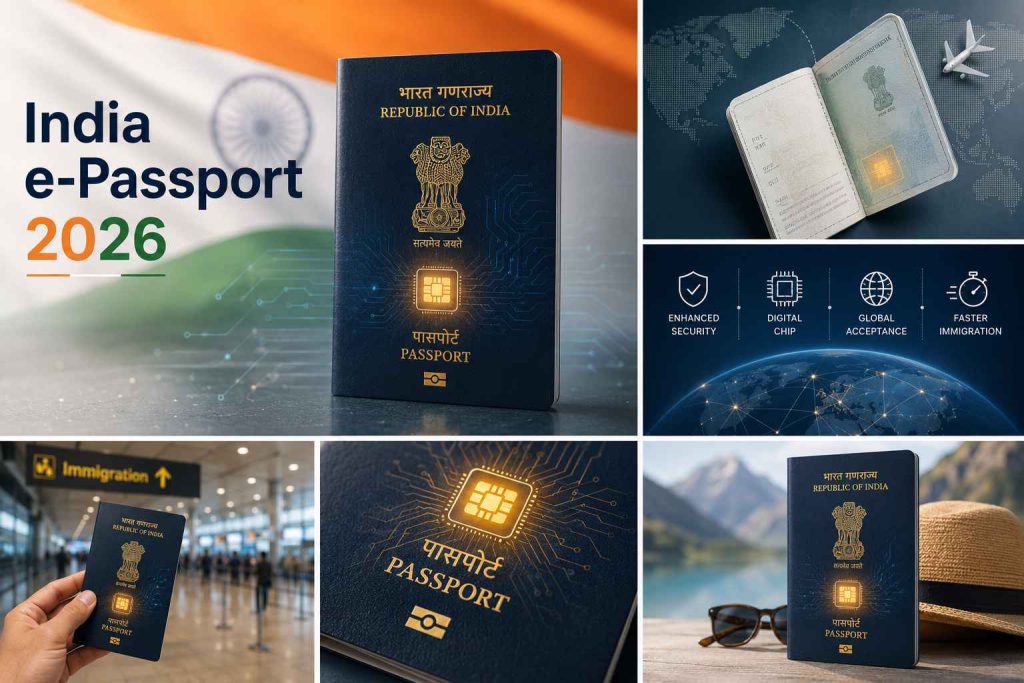
The India passport upgrade 2026 is being rolled out in phases. The Indian government, through the Ministry of External Affairs (MEA) and the Passport Seva Programme, has confirmed that e-Passports are being issued at select Passport Seva Kendras (PSKs) across the country, with a nationwide rollout planned progressively through 2026.
Key rollout points to know:
- Pilot cities including Nagpur, Bhubaneswar, Chennai, Hyderabad, and others are already issuing e-Passports
- New applicants at enabled PSKs will automatically receive the digital passport in India
- Existing passport holders do NOT need to immediately upgrade — their current passport remains valid until expiry
- The chip passport India format will gradually become the standard for all new issuances nationwide
As a travel agent, the most important thing to communicate is: there is no panic-upgrade needed. Current passports are still fully valid. However, clients applying for a fresh or renewal passport should expect — and welcome — the e-Passport.
How to Apply for the e-Passport India: A Step-by-Step Guide
One of the most common questions you’ll receive is about the step by step process to apply for e-Passport in India 2026. The good news? The process is nearly identical to applying for a regular passport. Here’s what your clients need to do:
Step 1 — Visit the Passport Seva Portal Go to passportindia.gov.in and log in or register as a new user.
Step 2 — Fill the Application Form Select “Fresh Passport” or “Re-issue of Passport” and complete the online form carefully. The system will automatically determine if an e-Passport will be issued based on the applicant’s PSK.
Step 3 — Upload Required Documents Applicants will need proof of identity, address proof, date of birth certificate, and existing passport (for renewals).
Step 4 — Book an Appointment Schedule a visit to the nearest Passport Seva Kendra or Post Office Passport Seva Kendra (POPSK).
Step 5 — Attend the Appointment Biometric data (photograph and fingerprints) will be captured in-person — this is mandatory for the India e-Passport 2026.
Step 6 — Track and Receive After processing and police verification, the passport is dispatched via Speed Post directly to the applicant’s address.
Knowing the how to apply e-Passport India process inside out will save your clients hours of confusion — and save you endless follow-up calls.
e-Passport vs Regular Passport India: What Travel Agents Must Communicate Clearly
Here’s a critical point for your client consultations on e-Passport vs regular passport India: the two documents are NOT interchangeable in terms of future benefits, but are legally equivalent today.
Countries with automated e-gates (United States, UK, EU nations, Australia, UAE, Singapore, and more) will increasingly prioritise holders of biometric passports for fast-track processing. While Indian regular passport holders can still enter these countries, they may not qualify for automated lanes — leading to longer manual queues.
Advising clients who travel frequently — especially business travellers, students going abroad, or those visiting Schengen countries — to apply for the digital passport in India when their current passport is due for renewal is sound, practical advice.
Quick FAQs for Travel Agents to Keep Handy
Q: Will my client’s existing passport still work? Yes. Regular passports remain valid until their expiry date. No immediate action needed.
Q: Is the fee different for an e-Passport? Currently, the fee structure remains the same as a regular passport application.
Q: Can clients specifically request an e-Passport? At e-Passport enabled PSKs, it is issued automatically. Clients cannot “opt out.”
Q: Does the India e-Passport 2026 allow visa-free travel to new countries? No. Visa policies remain unchanged. The e-Passport improves processing speed and security, not visa entitlements.
Stay Ahead of the Curve in 2026
The India e-Passport 2026 isn’t a disruption — it’s an evolution. As a travel agent, being informed about everything travel agents need to know about India e-Passport 2026 positions you as a trusted expert your clients can rely on. Whether they’re renewing a passport before a holiday or applying fresh for their first international trip, your guidance on the India e-Passport 2026 will make their experience smoother, faster, and smarter.
Bookmark this guide. Share it with your team. And the next time a client asks about their chip passport India or wonders about the India passport upgrade 2026 — you’ll have all the answers ready.
This blog is intended for informational purposes. For the most current guidelines and PSK availability, always refer to the official Passport Seva Portal at passportindia.gov.in or the Ministry of External Affairs website.